
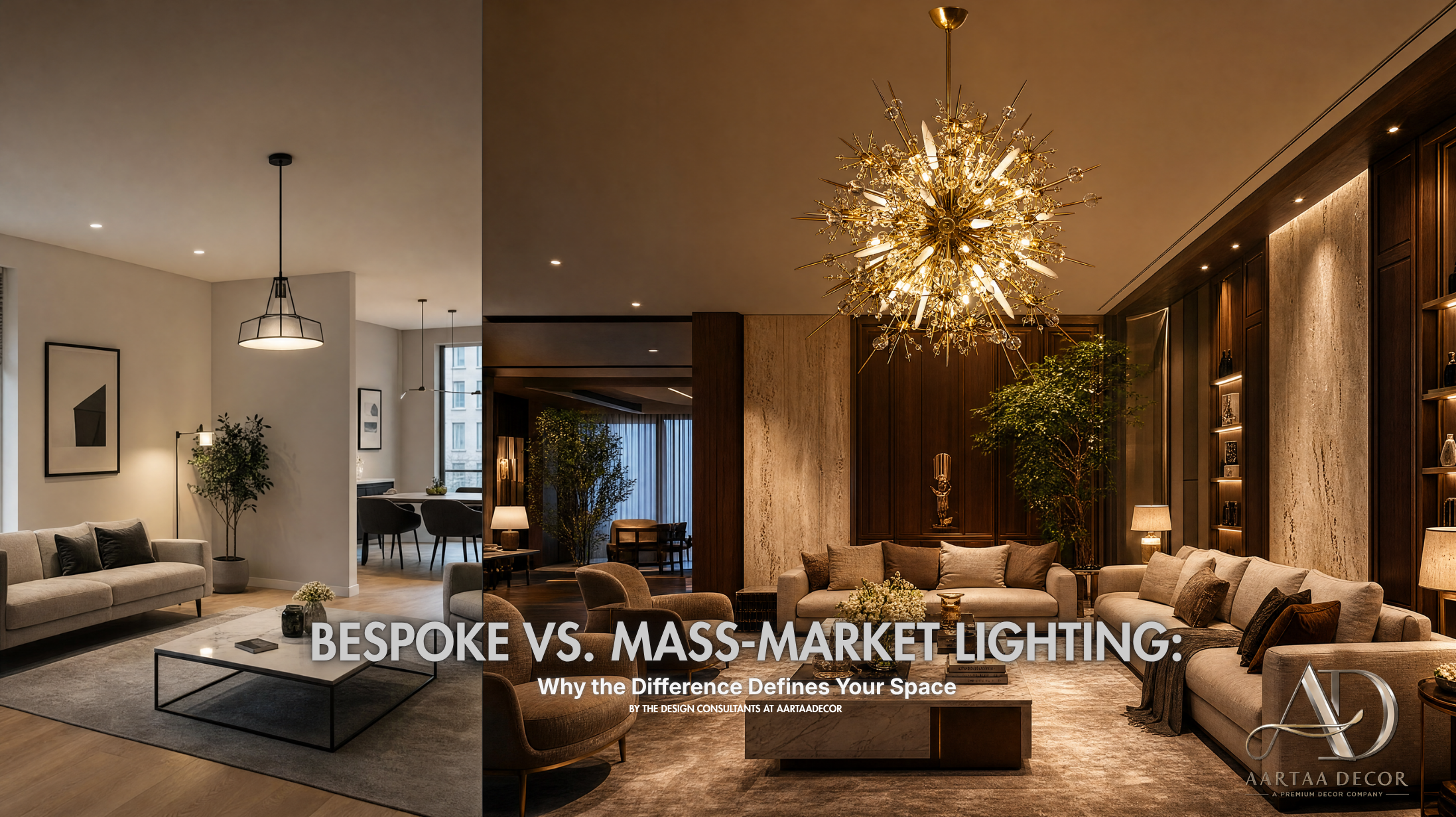
Bespoke vs. Mass-Market Lighting: Why the Difference Defines Your Space
A guide for architects, interior designers, hospitality professionals, and homeowners creating luxury interiors
Lighting is often described as the finishing touch in an interior.
At Aartaa Decor, we see it differently.
Light is the medium through which every other design decision is experienced. It determines how stone reveals its texture, how brass develops warmth, how timber appears after sunset, and how people feel when they enter a room.
A space may contain beautiful furniture, carefully detailed joinery, premium fabrics, and exceptional natural stone. Yet when the lighting is generic, poorly proportioned, or disconnected from the architecture, the room can still feel unresolved.
This is why the difference between bespoke lighting and mass-market lighting extends far beyond price.
It is a difference in design intention, craftsmanship, material quality, scale, customisation, longevity, and emotional impact.
Mass-market lighting occupies a space. Bespoke lighting helps define it.
In this guide, we explain what bespoke lighting truly means, how it differs from factory-produced alternatives, and when investing in a custom lighting design makes sense.
What Is Bespoke Lighting?
The term bespoke is frequently used in luxury design, but not every product marketed as bespoke has been created for a particular project.
Selecting a different colour, finish, or cable length from a standard catalogue is usually product customisation. True bespoke lighting goes further.
A bespoke light is developed around a specific brief that may include:
- Room dimensions and ceiling height
- Architectural style
- Desired proportions
- Interior materials and finishes
- Required light output
- Colour temperature
- Suspension length
- Electrical specifications
- Dimming and control systems
- Installation requirements
- The atmosphere the client wants to create
For example, a chandelier designed for a double-height foyer must respond to the height and width of the void, the staircase position, viewing angles, structural load points, and surrounding materials.
It should not simply be a larger version of a standard product. It should feel as though it belongs to that particular building.
At Aartaa Decor, our bespoke lighting and custom décor service allows dimensions, finishes, materials, lighting configurations, and installation requirements to be developed around the project.
Mass-market lighting follows a different model. Products are designed to appeal to many customers, fit standard packaging, support common installation conditions, and be manufactured efficiently in large quantities.
This makes mass-market lighting convenient and accessible. However, it also limits how precisely the fixture can respond to an individual interior.
Bespoke lighting is designed around the space. Mass-market lighting requires the space to accommodate the product.
Bespoke Lighting vs. Mass-Market Lighting
| Attribute | Bespoke Lighting | Mass-Market Lighting |
|---|---|---|
| Design origin | Created or adapted for a particular project | Designed for broad commercial appeal |
| Scale | Developed according to room and ceiling dimensions | Available in predetermined sizes |
| Materials | May include solid brass, bronze, hand-blown glass, crystal, marble, alabaster, silk, or linen | Often uses plated metal, moulded glass, acrylic, resin, or synthetic textiles |
| Customisation | Dimensions, finish, material, drop, light source, and mounting can be specified | Usually limited to colour or size variants |
| Craftsmanship | Frequently includes hand-finishing and artisan processes | Primarily factory-based production |
| Lead time | Made to order and coordinated with the project programme | Often available immediately or within a shorter period |
| Repairability | Components may be repairable, refinished, or replaced | Replacement of the full fitting may be more common |
| Visual identity | Distinctive and connected to the project | Familiar and repeatable |
| Design support | Collaborative development and technical coordination | Primarily a retail transaction |
| Best suited for | Luxury homes, villas, hotels, restaurants, foyers, and landmark spaces | Rentals, temporary interiors, budget projects, and fast fit-outs |
Neither option is automatically right for every project.
Mass-market lighting may be suitable for rental properties, temporary installations, secondary rooms, or projects where speed and cost are the primary considerations.
Bespoke lighting becomes valuable when the interior needs:
- Unusual dimensions
- A prominent focal point
- Project-specific finishes
- Premium natural materials
- Technical integration
- A distinctive brand identity
- A fixture that complements the architecture
The Three Main Differences
1. Design Intention
Every successful bespoke lighting commission begins with a purpose.
The light may need to anchor an entrance, create rhythm above a kitchen island, introduce intimacy into a dining room, or become a recognisable installation within a hotel lobby.
Its form, scale, material, finish, and illumination are chosen to support that purpose.
Mass-market lighting must work in many different environments. As a result, its proportions and forms are generally designed to be broadly acceptable.
Bespoke lighting can be more specific.
It can respond to:
- An unusually tall staircase
- A curved ceiling
- A long dining table
- A hotel’s design identity
- A regional craft tradition
- A particular stone or timber finish
- The geometry of windows and columns
A custom chandelier is therefore not simply decoration. It can become part of the architectural composition.
Architects and designers developing complex projects can also review our guide on how to write a professional chandelier brief.
2. Craftsmanship
Handcrafted lighting may involve processes that cannot be replicated at full industrial speed.
Depending on the design, these can include:
- Hand-shaping and filing metal
- Mouth-blowing glass
- Hand-cutting crystal
- Applying chemical patinas
- Carving natural stone
- Casting custom components
- Hand-pleating textile shades
- Detailed hand assembly
These processes may create subtle variations in tone, texture, shape, or finish.
Such variations are not necessarily imperfections. They are often evidence of the human hand and the material’s natural character.
In mass production, uniformity is essential. Components must be nearly identical so they can be assembled quickly and predictably.
In handcrafted lighting, consistency remains important, but individuality also has value.
Explore our collection of handcrafted chandeliers to see how decorative lighting can function as both illumination and sculptural design.
3. Longevity and Adaptability
A well-designed bespoke fitting can be created with long-term service, maintenance, and repair in mind.
Metalwork may be refinished. Electrical components may be updated. Glass, shades, crystals, or individual decorative elements may be replaceable.
Natural materials can also evolve attractively.
Solid brass may develop a deeper patina. Bronze can acquire greater tonal variation. Hand-blown glass continues to reveal slight differences as natural and artificial light changes throughout the day.
Mass-market products are usually optimised for efficient manufacture and replacement. Repairs may be difficult when individual components or finishes are unavailable.
For clients creating a permanent home, hotel, restaurant, or landmark interior, repairability can be an important part of long-term value.
Why Lighting Has Such a Strong Emotional Impact
People may not remember the technical specification of a chandelier or pendant light. They remember how the space made them feel.
Lighting influences:
- Whether a room feels warm or clinical
- How large or intimate it appears
- Which architectural features attract attention
- How materials and colours are perceived
- How comfortably people see one another
- The direction in which the eye travels
- How the room changes between day and night
This is particularly important in luxury hospitality.
A memorable hotel lobby rarely relies on one uniform source of illumination. It generally combines ambient lighting, architectural illumination, accent lighting, decorative fixtures, and carefully controlled shadows.
A statement chandelier can become the centre of this composition.
Its scale, material depth, position, and glow contribute to the visitor’s perception of quality and care.
For examples of site-responsive hospitality lighting, read our feature on luxury hotels shaped by bespoke Indian lighting.
Colour Temperature and Luxury Interiors
Colour temperature is one of the most influential parts of a lighting specification.
Warm-white light around 2700K to 3000K is commonly considered for residential and hospitality interiors where the desired atmosphere is comfortable and inviting.
Warm light can complement:
- Brass and bronze
- Natural timber
- Leather
- Warm-toned marble
- Textiles
- Decorative finishes
Cooler light may be appropriate for workspaces, galleries, retail applications, bathrooms, or highly contemporary interiors. The selection should depend on the purpose of the room rather than a universal rule.
The Illuminating Engineering Society’s definition of colour temperature provides useful technical context, while the Department of Energy’s lighting guidance explains how colour temperature affects the appearance of emitted light.
Colour temperature should be evaluated alongside colour rendering, dimming compatibility, brightness, materials, and the intended mood.
How Bespoke Lighting Is Used in Luxury Homes
In a well-resolved home, lighting helps establish hierarchy.
Not every room requires an oversized chandelier. Instead, the strongest residential schemes identify a few important moments where custom lighting will have the greatest effect.
These may include:
- A sculptural chandelier in the entrance
- A cascading installation above a staircase
- Pendants over a dining table
- Custom lights above a kitchen island
- Wall sconces beside a bed
- Decorative lighting in a formal living room
- An installation within a courtyard or double-height void
The fixture should relate to the architecture rather than compete with it.
A custom light might repeat the rhythm of windows, follow the curve of a staircase, align with a table, or introduce an organic contrast within a geometrically structured room.
For dining rooms, lounges, kitchen islands, and smaller foyers, our handcrafted pendant-light collection provides a useful starting point.
Bespoke Lighting for Hotels and Restaurants
In hospitality design, lighting forms part of both the guest experience and the property’s visual identity.
A signature lighting installation may appear in:
- Guest photographs
- Social-media content
- Editorial features
- Advertising campaigns
- Booking-platform images
- Hotel brochures and brand films
A chandelier created specifically for a lobby cannot be experienced in exactly the same way elsewhere. It can become associated with that destination.
In restaurants, custom lighting can establish intimacy, organise seating areas, support food presentation, and create a recognisable evening atmosphere.
In resorts, lighting may reference local landscapes, regional materials, traditional craftsmanship, or organic forms.
The strongest hospitality fixtures do not merely look impressive. They communicate something meaningful about the property.
Bespoke Lighting for Architects and Interior Designers
Complex lighting projects require coordination between creative and technical teams.
Architects and interior designers should consider decorative lighting during the planning stage rather than waiting until the room is nearly complete.
Early coordination allows the team to resolve:
- Ceiling reinforcement
- Structural load points
- Electrical positions
- Driver locations
- Suspension systems
- Access for maintenance
- Installation sequencing
- Dimming compatibility
- Control-system requirements
A large chandelier specified too late may need to compromise in scale, position, weight, or electrical performance.
Aartaa Decor works with design professionals through our trade and architect partnership programme, supporting custom dimensions, finishes, materials, project quotations, and specification requirements.
How Materials Affect the Quality of Light
Material selection is not only an aesthetic decision. It changes how light is reflected, absorbed, diffused, and transmitted.
Solid Brass
Solid brass provides visual depth and weight. It can be polished, brushed, antiqued, burnished, or chemically patinated.
Unlike a thin metallic coating, the material itself contributes to the character of the piece.
Hand-Blown Glass
Hand-blown glass may contain small variations in thickness, shape, and tone.
These variations affect the way light passes through the glass, creating a more organic effect than perfectly uniform moulded components.
Crystal
Cut crystal interacts actively with light.
Its facets can produce reflections, highlights, and prismatic effects across nearby ceilings and walls.
Alabaster and Onyx
Translucent natural stone can look almost solid when unlit and glow when illuminated from within.
Natural veining makes every component slightly different.
Bronze
Hand-applied bronze patinas can contain several layers of colour and tonal depth.
This produces a different effect from a painted imitation finish applied over another metal.
Silk and Linen
Natural textile shades soften and diffuse light.
The weave, lining, colour, pleating, and thickness influence the outward glow and the direction of illumination.
In bespoke lighting, the material does not simply form the fixture. It shapes the light itself.
Best Practices for Specifying Bespoke Lighting
Commission Early
Bespoke pieces should be included in the project schedule from the beginning.
This gives the design and manufacturing teams time to develop the form, confirm materials, review drawings, coordinate electrical requirements, and plan installation.
Establish a Lighting Narrative
Before choosing individual fixtures, define how each room should feel.
The entrance may need to feel dramatic and welcoming. The dining room may require warmth and intimacy. A lounge may need several different scenes for reading, entertaining, and conversation.
Coordinate Finishes
Review lighting finishes alongside:
- Door and cabinet hardware
- Furniture metals
- Stone samples
- Timber tones
- Wall colours
- Decorative accessories
The finishes do not need to match exactly, but their relationship should be intentional.
Specify Dimming
A luxury interior should not remain at one brightness level throughout the day.
Dimming allows a room to transition between practical, social, and intimate settings. The lamp, driver, control system, and dimming protocol must be compatible.
Consider the Ceiling Plane
A chandelier affects more than the space beneath it.
Its shadows, reflections, upward glow, and mounting system also influence the ceiling. These effects should be considered during design development.
Collaborate With the Maker
Useful information for a bespoke lighting consultation includes:
- Plans and elevations
- Reflected ceiling plans
- Site photographs
- Room dimensions
- Ceiling height
- Mood boards
- Material samples
- Finish references
- Electrical specifications
- Installation restrictions
- Budget and timeline
Read our complete bespoke lighting design guide for further project-planning advice.
Common Lighting Mistakes
Choosing Size According to Price
A light that is too small can disappear in a large room.
Begin by determining the proportions required by the architecture. The design and material specification can then be adjusted around the available budget.
Treating Lighting as an Afterthought
When lighting is selected at the end of a project, options become limited.
Early planning gives the team greater control over positioning, scale, support, electrical requirements, and visual impact.
Ignoring Colour Temperature
A beautifully crafted fixture can still feel uncomfortable when its light source conflicts with the materials or purpose of the room.
Evaluate physical samples under the proposed colour temperature before approval.
Selecting Lighting in Isolation
A chandelier may look exceptional in a showroom but feel disconnected from the stone, timber, metalwork, furniture, and scale of the final interior.
Assess the light as part of the complete material palette.
Assuming Expensive Means Bespoke
A premium price does not automatically mean that a fixture is bespoke.
The defining question is:
Was the piece developed in response to the dimensions, materials, technical requirements, and atmosphere of this particular space?
Is Bespoke Lighting Worth the Investment?
Bespoke lighting may be worth considering when:
- The room has unusual proportions
- A standard fixture looks too small or too large
- The lighting must match specific finishes
- The project requires a recognisable focal point
- The client wants natural or premium materials
- The fixture must integrate with technical systems
- Repairability and long-term use are priorities
- The interior requires a unique design identity
Mass-market lighting remains suitable when affordability, immediate availability, and simple installation matter more than individuality.
The decision should therefore be based on the role the light needs to play.
For an unobtrusive utility room fitting, bespoke production may be unnecessary. For a hotel lobby, entrance hall, dining room, staircase, or double-height residence, a project-specific piece can transform the entire composition.
The Future of Bespoke Lighting
Smart Integration
Clients increasingly expect decorative lighting to work with dimming systems, scene controls, home automation, and building-management platforms.
The best integrations keep drivers, cables, sensors, and control components visually discreet.
Technology should improve the experience without dominating the handcrafted object.
Sustainability and Repairability
A fixture created from durable materials and designed for maintenance can remain in use longer than a product that must be completely replaced when one component fails.
Important considerations include:
- Replaceable electrical components
- Efficient LED sources
- Responsible material selection
- Recyclable metals
- Lower-impact finishes
- Repairable construction
- Reduced packaging
- Local or regional craftsmanship
Organic and Biophilic Forms
Contemporary custom lighting increasingly draws inspiration from branches, flowers, leaves, water, stones, and other natural structures.
These compositions benefit from handcraft because organic forms require visual judgment, controlled irregularity, balance, and rhythm.
The objective is not always to imitate nature literally. It is to introduce movement, softness, and individuality into the interior.
Final Thoughts
There are products created to satisfy a temporary need, and there are objects designed to become part of the identity of a place.
Bespoke lighting belongs to the second category.
It represents a decision about the attention given to scale, atmosphere, craftsmanship, material quality, and the experience of everyone who enters the space.
Mass-market lighting can be practical, affordable, and appropriate. However, it is generally designed to remain replaceable and broadly suitable.
Bespoke lighting has a different ambition.
It is created to respond to the architecture, support the interior narrative, and bring a distinctive quality to the space.
Mass-market lighting asks little of the room around it. Bespoke lighting has the power to transform it.
At Aartaa Decor, we create luxury lighting and handcrafted decorative pieces for residences, villas, hotels, restaurants, architects, and interior designers.
To discuss a custom chandelier, pendant, wall light, or large-scale installation, request a bespoke lighting consultation.
Frequently Asked Questions
What is bespoke lighting?
Bespoke lighting is designed or substantially customised for a particular project. Its dimensions, materials, finish, mounting, light source, and technical specifications can be developed around the space.
What is the difference between bespoke and mass-market lighting?
Bespoke lighting responds to a specific brief, while mass-market lighting is produced in standard designs and sizes for a broad range of customers.
Is bespoke lighting suitable for homes?
Yes. It is commonly considered for entrances, dining rooms, staircases, double-height spaces, kitchen islands, living rooms, and principal bedrooms.
Can a chandelier be customised according to ceiling height?
Yes. Its diameter, overall height, suspension length, number of tiers, and arrangement can be adjusted according to room dimensions and installation requirements.
Which materials are used in handcrafted luxury lighting?
Materials may include brass, bronze, crystal, hand-blown glass, marble, alabaster, onyx, timber, silk, linen, and other decorative components.
How should architects brief a bespoke lighting manufacturer?
The brief should include room dimensions, ceiling height, placement, drawings, reference images, material preferences, electrical requirements, budget, timeline, and installation conditions.
Where can I commission bespoke lighting in India?
Aartaa Decor provides bespoke lighting and custom decorative solutions for homeowners, architects, designers, hospitality properties, and premium projects across India and internationally.